

Who Is Responsible For Cleaning Up Oil Spills In Canada
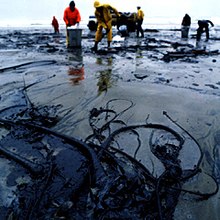
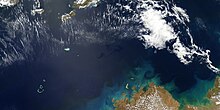
An oil spill is the release of a liquid petroleum hydrocarbon into the environment, especially the marine ecosystem, due to human activeness, and is a course of pollution. The term is usually given to marine oil spills, where oil is released into the ocean or littoral waters, but spills may too occur on country. Oil spills may be due to releases of crude oil from tankers, offshore platforms, drilling rigs and wells, likewise equally spills of refined petroleum products (such as gasoline, diesel) and their by-products, heavier fuels used by large ships such every bit bunker fuel, or the spill of any oily refuse or waste product oil.
Oil spills penetrate into the structure of the plumage of birds and the fur of mammals, reducing its insulating ability, and making them more than vulnerable to temperature fluctuations and much less buoyant in the water. Cleanup and recovery from an oil spill is difficult and depends upon many factors, including the type of oil spilled, the temperature of the h2o (affecting evaporation and biodegradation), and the types of shorelines and beaches involved.[1] Spills may take weeks, months or fifty-fifty years to clean up.[ii]
Oil spills can have disastrous consequences for order; economically, environmentally, and socially. Every bit a issue, oil spill accidents accept initiated intense media attention and political uproar, bringing many together in a political struggle concerning regime response to oil spills and what deportment can best prevent them from happening.[3] fatflop
zift
Largest oil spills [edit]
Crude oil and refined fuel spills from tanker transport accidents accept damaged vulnerable ecosystems in Alaska, the Gulf of Mexico, the Galapagos Islands, France, the Sundarbans, Ogoniland, and many other places. The quantity of oil spilled during accidents has ranged from a few hundred tons to several hundred thousand tons (e.one thousand., Deepwater Horizon Oil Spill, Atlantic Empress, Amoco Cadiz),[four] but volume is a limited measure out of damage or impact. Smaller spills have already proven to have a great bear upon on ecosystems, such equally the Exxon Valdez oil spill because of the remoteness of the site or the difficulty of an emergency ecology response.
Since 2004, between 300 and 700 barrels of oil per day have been leaking from the site of an oil-production platform 12 miles off the Louisiana coast which sank in the aftermath of Hurricane Ivan. The oil spill, which officials estimate could continue throughout the 21st century, volition eventually overtake the 2010 BP Deepwater Horizon disaster every bit the largest ever, but there are currently no efforts to cap the many leaking well heads.[5]
Oil spills at body of water are more often than not much more dissentious than those on land, since they can spread for hundreds of nautical miles in a thin oil slick which tin cover beaches with a thin blanket of oil. These can impale seabirds, mammals, shellfish and other organisms they coat. Oil spills on land are more than readily containable if a makeshift earth dam tin can exist rapidly bulldozed around the spill site before nearly of the oil escapes, and state animals can avert the oil more than easily.
| Spill / Tanker | Location | Date | Tonnes of rough oil (thousands)[a] | Barrels (thousands) | US Gallons (thousands) | References |
|---|---|---|---|---|---|---|
| Kuwaiti Oil Fires[b] | Kuwait | Jan 16, 1991 – November 6, 1991 | 136,000 | i,000,000 | 42,000,000 | [6] [7] |
| Kuwaiti Oil Lakes [c] | Kuwait | January 1991 – November 1991 | 3,409–6,818 | 25,000–l,000 | 1,050,000–two,100,000 | [eight] [9] [10] |
| Lakeview Gusher | Kern County, California, USA | March fourteen, 1910 – September 1911 | ane,200 | 9,000 | 378,000 | [11] |
| Gulf State of war oil spill [d] | Kuwait, Iraq, and the Persian Gulf | January nineteen, 1991 – January 28, 1991 | 818–1,091 | half-dozen,000–8,000 | 252,000–336,000 | [nine] [13] [14] |
| Deepwater Horizon | Usa, Gulf of Mexico | April 20, 2010 – July 15, 2010 | 560–585 | four,100–iv,900 | 189,000–231,000 | [15] [16] [17] [18] [19] |
| Ixtoc I | United mexican states, Gulf of Mexico | June 3, 1979 – March 23, 1980 | 454–480 | three,329–three,520 | 139,818–147,840 | [20] [21] [22] |
| Atlantic Empress / Aegean Captain | Trinidad and Tobago | July 19, 1979 | 287 | 2,105 | 88,396 | [23] [24] [25] |
| Fergana Valley | Uzbekistan | March two, 1992 | 285 | 2,090 | 87,780 | [26] |
| Nowruz Field Platform | Iran, Persian Gulf | February iv, 1983 | 260 | ane,900 | lxxx,000 | [27] |
| ABT Summer | Angola, 700 nmi (ane,300 km; 810 mi) offshore | May 28, 1991 | 260 | 1,907 | 80,080 | [23] |
| Castillo de Bellver | South Africa, Saldanha Bay | August 6, 1983 | 252 | one,848 | 77,616 | [23] |
| Amoco Cadiz | France, Brittany | March 16, 1978 | 223 | i,635 | 68,684 | [23] [26] [28] [29] |
| Taylor Energy | United States, Gulf of Mexico | September 23, 2004 – Present | 210–490 | one,500–3,500 | 63,000–147,000 | [xxx] |
| Odyssey | off the coast of Nova Scotia, Canada | Nov 10, 1988 | 132 | 968 | 40,704 | [31] |
| Torrey Canyon | England, Cornwall | March 18, 1967 | 119 | 872 | 36,635 | [32] |
- ^ 1 metric ton (tonne) of crude oil is roughly equal to 308 United states of america gallons or seven.33 barrels approx.; 1 oil barrel (bbl) is equal to 35 imperial or 42 US gallons. Approximate conversion factors. Archived 2014-06-21 at the Wayback Machine
- ^ Estimates for the corporeality of oil burned in the Kuwaiti Oil Fires range from 500,000,000 barrels (79,000,000 m3) to well-nigh two,000,000,000 barrels (320,000,000 thousand3). Betwixt 605 and 732 wells were set ablaze, while many others were severely damaged and gushed uncontrolled for several months. It took over ten months to bring all of the wells under control. The fires alone were estimated to consume approximately 6,000,000 barrels (950,000 k3) of oil per day at their summit.
- ^ Oil spilled from sabotaged fields in Kuwait during the 1991 Western farsi Gulf War pooled in approximately 300 oil lakes, estimated by the Kuwaiti Oil Minister to contain approximately 25,000,000 to fifty,000,000 barrels (7,900,000 thousandthree) of oil. According to the U.S. Geological Survey, this effigy does not include the corporeality of oil absorbed by the ground, forming a layer of "tarcrete" over approximately 5 per centum of the surface of State of kuwait, fifty times the area occupied by the oil lakes.[8]
- ^ Estimates for the Gulf State of war oil spill range from 4,000,000 to 11,000,000 barrels (1,700,000 mthree). The figure of 6,000,000 to 8,000,000 barrels (1,300,000 1000three) is the range adopted by the U.Southward. Environmental Protection Agency and the United Nations in the immediate aftermath of the war, 1991–1993, and is still electric current, equally cited by NOAA and The New York Times in 2010.[12] This amount only includes oil discharged directly into the Persian Gulf past the retreating Iraqi forces from Jan 19 to 28, 1991. Nonetheless, co-ordinate to the U.North. report, oil from other sources not included in the official estimates connected to cascade into the Farsi Gulf through June, 1991. The amount of this oil was estimated to be at least several hundred thousand barrels, and may have factored into the estimates above 8,000,000 barrels (ane,300,000 grand3).
Human being touch on [edit]
An oil spill represents an immediate fire risk. The Kuwaiti oil fires produced air pollution that caused respiratory distress.[ commendation needed ] The Deepwater Horizon explosion killed eleven oil rig workers.[33] The fire resulting from the Lac-Mégantic derailment killed 47 and destroyed one-half of the town's centre.[ commendation needed ]
Spilled oil tin also contaminate drinking h2o supplies. For example, in 2013 two dissimilar oil spills contaminated h2o supplies for 300,000 in Miri, Malaysia;[34] 80,000 people in Coca, Ecuador.[35] In 2000, springs were contaminated by an oil spill in Clark County, Kentucky.[36]
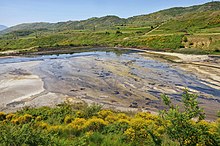
Ballsh, Mallakaster, Albania 2019 17 - Crude Oil
Contamination tin can have an economic impact on tourism and marine resources extraction industries. For example, the Deepwater Horizon oil spill impacted embankment tourism and line-fishing along the Gulf Coast, and the responsible parties were required to compensate economic victims.
Environmental furnishings [edit]
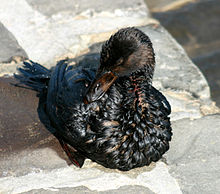
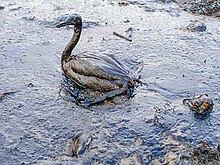
A bird covered in oil from the Blackness Sea oil spill
The threat posed to birds, fish, shellfish and crustaceans from spilled oil was known in England in the 1920s, largely through observations made in Yorkshire.[37] The subject was also explored in a scientific paper produced by the National University of Sciences in the US in 1974 which considered impacts to fish, crustaceans and molluscs. The newspaper was express to 100 copies and was described as a draft document, non to exist cited.[38]
In general, spilled oil can affect animals and plants in two ways: dirесt from the oil and from the response or cleanup process.[39] [40] There is no articulate relationship betwixt the amount of oil in the aquatic environment and the likely bear on on biodiversity. A smaller spill at the incorrect time/wrong season and in a sensitive environment may prove much more harmful than a larger spill at another time of the year in some other or fifty-fifty the same environment.[41] Oil penetrates into the structure of the feather of birds and the fur of mammals, reducing their insulating ability, and making them more vulnerable to temperature fluctuations and much less buoyant in the h2o.
Animals who rely on scent to find their babies or mothers cannot due to the strong scent of the oil. This causes a babe to be rejected and abased, leaving the babies to starve and eventually dice. Oil tin can impair a bird's ability to fly, preventing it from foraging or escaping from predators. Every bit they preen, birds may ingest the oil blanket their feathers, irritating the digestive tract, altering liver role, and causing kidney damage. Together with their diminished foraging capacity, this can apace result in dehydration and metabolic imbalance. Some birds exposed to petroleum as well experience changes in their hormonal remainder, including changes in their luteinizing poly peptide.[42] The majority of birds affected by oil spills dice from complications without human intervention.[43] [44] Some studies have suggested that less than 1 percent of oil-soaked birds survive, even subsequently cleaning,[45] although the survival rate can also exceed ninety percent, as in the example of the MV Treasure oil spill.[46] Oil spills and oil dumping events have been impacting sea birds since at to the lowest degree the 1920s[47] [48] [49] and was understood to be a global problem in the 1930s.[50]
Heavily furred marine mammals exposed to oil spills are affected in like ways. Oil coats the fur of sea otters and seals, reducing its insulating effect, and leading to fluctuations in body temperature and hypothermia. Oil can besides blind an animal, leaving it defenseless. The ingestion of oil causes dehydration and impairs the digestive process. Animals can be poisoned, and may die from oil entering the lungs or liver.
At that place are iii kinds of oil-consuming bacteria. Sulfate-reducing bacteria (SRB) and acrid-producing bacteria are anaerobic, while full general aerobic bacteria (GAB) are aerobic. These bacteria occur naturally and will deed to remove oil from an ecosystem, and their biomass will tend to replace other populations in the food concatenation. The chemicals from the oil which deliquesce in water, and hence are available to leaner, are those in the water associated fraction of the oil.
In add-on, oil spills can also harm air quality.[51] The chemicals in crude oil are by and large hydrocarbons that contains toxic chemicals such every bit benzenes, toluene, poly-aromatic hydrocarbon and oxygenated polycyclic effluvious hydrocarbons. These chemicals can innovate adverse health furnishings when being inhaled into human body. In addition, these chemicals can be oxidized past oxidants in the temper to course fine particulate matter after they evaporate into the temper.[52] These particulates can penetrate lungs and carry toxic chemicals into the human body. Burning surface oil can also be a source for pollution such as soot particles. During the cleanup and recovery process, it will also generate air pollutants such as nitric oxides and ozone from ships. Lastly, bubble bursting tin can likewise be a generation pathway for particulate matter during an oil spill.[53] During the Deepwater Horizon oil spill, significant air quality issues were establish on the Gulf Coast, which is the downwind of DWH oil spill. Air quality monitoring information showed that criteria pollutants had exceeded the health-based standard in the coastal regions.[54]
Sources and rate of occurrence [edit]
Oil spills can be caused by human fault, natural disasters, technical failures or deliberate releases.[55] [56] It is estimated that 30-50% of all oil spills are directly or indirectly caused by human error, with approximately 20-40% of oil spills being attributed to equipment failure or malfunction.[57] Causes of oil spills are further distinguished betwixt deliberate releases, such as operational discharges or acts of state of war and adventitious releases. Accidental oil spills are in the focus of the literature, although some of the largest oil spills always recorded, the Gulf War Oil Spill (bounding main based) and Kuwaiti Oil Fires (land based) were deliberate acts of war.[58] The academic study of sources and causes of oil spills identifies vulnerable points in oil transportation infrastructure and calculates the likelihood of oil spills happening. This tin can then guide prevention efforts and regulation policies[59]
Natural seeps [edit]
Around xl-50% of all oil released into the oceans stems from natural seeps from seafloor rocks. This corresponds to approximately 600,000 tons annually on a global level. While natural seeps are the single largest source of oil spills, they are considered less problematic because ecosystems have adapted to such regular releases. For instance, on sites of natural oil seeps, ocean bacteria have evolved to digest oil molecules.[60] [61] [58]
Oil tankers and vessels [edit]
Vessels can exist the source of oil spills either through operational releases of oil or in the case of oil tanker accidents. Operational discharges from vessels are estimated to account for 21% of oil releases from vessels.[61] They occur as a result of failure to comply with regulations or capricious discharges of waste product oil and water containing such oil residues.[62] Such operational discharges are regulated through the MARPOL convention.[63] Operational releases are frequent, merely small in the amount of oil spilled per release, and are often non in the focus of attending regarding oil spills.[61] In that location has been a steady subtract of operational discharges of oil, with an additional decrease of around 50% since the 1990s.[58]
Accidental oil tank vessel spills account for approximately 8-13% of all oil spilled into the oceans.[61] [64] The main causes of oil tank vessel spills are standoff (29%), grounding (22%), mishandling (xiv%) and sinking (12%), among others.[61] [65] Oil tanker spills are considered a major ecological threat due to the big amount of oil spilled per accident and the fact that major ocean traffic routes are close to Large Marine Ecosystems.[61] Around 90% of the world's oil transportation is through oil tankers, and the absolute amount of seaborne oil trade is steadily increasing.[64] All the same, there has been a reduction of the number of spills from oil tankers and of the amount of oil released per oil tanker spill.[64] [58] In 1992, MARPOL was amended and made it mandatory for large tankers (5,000 dwt and more) to be fitted with double hulls.[66] This is considered to be a major reason for the reduction of oil tanker spills, alongside other innovations such as GPS, sectioning of vessels and sea lanes in narrow straits.[58] [61]
Offshore oil platforms [edit]

Chemic dispersants may be deployed from boats, planes, and underwater vehicles in response to an offshore oil spill
Accidental spills from oil platforms nowadays account for approximately iii% of oil spills in the oceans.[61] Prominent offshore oil platform spills typically occurred every bit a issue of a blowout. They can keep for months until relief wells have been drilled, resulting in enormous amounts of oil leaked.[58] Notable examples of such oil spills are Deepwater Horizon and Ixtoc I. While technologies for drilling in deep water have significantly improved in the by thirty–40 years, oil companies move to drilling sites in more and more than hard places. This cryptic evolution results in no clear tendency regarding the frequency of offshore oil platform spills.[58]
Pipelines [edit]
Pipelines as sources of oil spills are estimated to contribute ane% of oil pollution to the oceans.[61] Reasons for this are underreporting, and many oil pipeline leaks occur on land with only fractions of that oil reaching the oceans. Overall, yet, there has been a substantial increment of pipeline oil spills in the past 4 decades.[58] Prominent examples include oil spills of pipelines in the Niger Delta. Pipeline oil spills can be caused by trawling of fishing boats, natural disasters, pipe corrosion, construction defects and deliberate sabotage or attacks,[62] every bit with the Caño Limón-Coveñas pipeline in Colombia.
Other sources [edit]
Recreational boats tin can spill oil into the ocean because of operational or human error and unpreparedness. The amounts are even so small, and such oil spills are hard to track due to underreporting.[60]
Oil can reach the oceans as oil and fuel from land-based sources.[57] It is estimated that runoff oil and oil from rivers are responsible for 11% of oil pollution to the oceans.[61] Such pollution tin likewise exist oil on roads from state vehicles, which is then flushed into the oceans during rainstorms.[60] Purely land-based oil spills are unlike from maritime oil spills in that oil on state does non spread every bit rapidly as in water, and effects thus remain local.[57]
Cleanup and recovery [edit]


A The states Navy oil spill response team drills with a "Harbour Buster high-speed oil containment system".
Cleanup and recovery from an oil spill is hard and depends upon many factors, including the type of oil spilled, the temperature of the water (affecting evaporation and biodegradation), and the types of shorelines and beaches involved.[1] Physical cleanups of oil spills are too very expensive. Still, microorganisms such as Fusobacteria species demonstrate potential for future oil spill cleanup because of their power to colonize and degrade oil slicks on the sea surface.[67]
Methods for cleaning up include:[68]
- Bioremediation: utilize of microorganisms[69] or biological agents[70] to break downwardly or remove oil; such every bit Alcanivorax leaner[71] or Methylocella silvestris.[72]
- Bioremediation Accelerator: a binder molecule that moves hydrocarbons out of h2o and into gels, when combined with nutrients, encourages natural bioremediation. Oleophilic, hydrophobic chemical, containing no bacteria, which chemically and physically bonds to both soluble and insoluble hydrocarbons. The accelerator acts equally a herding agent in water and on the surface, floating molecules such every bit phenol and BTEX to the surface of the h2o, forming gel-like agglomerations. Undetectable levels of hydrocarbons can be obtained in produced h2o and manageable h2o columns. By overspraying sheen with bioremediation accelerator, sheen is eliminated within minutes. Whether applied on land or on water, the nutrient-rich emulsion creates a bloom of local, indigenous, pre-existing, hydrocarbon-consuming bacteria. Those specific leaner interruption down the hydrocarbons into water and carbon dioxide, with EPA tests showing 98% of alkanes biodegraded in 28 days; and aromatics being biodegraded 200 times faster than in nature they also sometimes use the hydrofireboom to clean the oil up by taking information technology away from most of the oil and burning it.[73]
- Controlled burning tin effectively reduce the amount of oil in water, if washed properly.[74] But it can just be done in low wind,[75] and tin cause air pollution.[76]


- Dispersants can be used to dissipate oil slicks.[77] A dispersant is either a non-surface agile polymer or a surface-agile substance added to a break, usually a colloid, to better the separation of particles and to prevent settling or clumping. They may rapidly disperse big amounts of sure oil types from the ocean surface by transferring information technology into the water column. They volition cause the oil slick to break upwards and form water-soluble micelles that are rapidly diluted. The oil is and so effectively spread throughout a larger volume of water than the surface from where the oil was dispersed. They tin also delay the formation of persistent oil-in-water emulsions. However, laboratory experiments showed that dispersants increased toxic hydrocarbon levels in fish by a gene of up to 100 and may kill fish eggs.[78] Dispersed oil droplets infiltrate into deeper water and can lethally contaminate coral. Inquiry indicates that some dispersants are toxic to corals.[79] A 2012 study found that Corexit dispersant had increased the toxicity of oil by up to 52 times.[80] In 2019, the U.South. National Academies released a written report analyzing the advantages and disadvantages of several response methods and tools.[81]
- Watch and wait: in some cases, natural attenuation of oil may exist about advisable, due to the invasive nature of facilitated methods of remediation, specially in ecologically sensitive areas such equally wetlands.[82]
- Dredging: for oils dispersed with detergents and other oils denser than water.
- Skimming: Requires calm waters at all times during the procedure. Vessels used for skimming clean up are called Gulp Oil Skimmers.[83]
- Solidifying: Solidifiers are composed of tiny, floating, dry out ice pellets,[84] [85] [86] and hydrophobic polymers that both adsorb and blot. They clean upwardly oil spills past changing the concrete country of spilled oil from liquid to a solid, semi-solid or a prophylactic-similar material that floats on h2o.[twoscore] Solidifiers are insoluble in water, therefore the removal of the solidified oil is piece of cake and the oil will not leach out. Solidifiers have been proven to be relatively not-toxic to aquatic and wildlife and have been proven to suppress harmful vapors commonly associated with hydrocarbons such as benzene, xylene and naphtha. The reaction time for solidification of oil is controlled by the surface expanse or size of the polymer or dry pellets equally well as the viscosity and thickness of the oil layer. Some solidifier product manufacturers claim the solidified oil can be thawed and used if frozen with dry ice or disposed of in landfills, recycled as an additive in asphalt or rubber products, or burned every bit a low ash fuel. A solidifier called C.I.Agent (manufactured by C.I.Amanuensis Solutions of Louisville, Kentucky) is beingness used past BP in granular grade, every bit well every bit in Marine and Sheen Booms at Dauphin Island and Fort Morgan, Alabama, to aid in the Deepwater Horizon oil spill cleanup.
- Vacuum and centrifuge: oil can exist sucked up forth with the water, and and then a centrifuge can be used to separate the oil from the water – allowing a tanker to be filled with near pure oil. Usually, the water is returned to the ocean, making the process more efficient, merely assuasive small amounts of oil to go back also. This issue has hampered the use of centrifuges due to a U.s.a. regulation limiting the corporeality of oil in water returned to the sea.[87]
- Beach Raking: coagulated oil that is left on the beach can be picked up by machinery.

Equipment used includes:[74]
- Booms: large floating barriers that round up oil and lift the oil off the h2o
- Skimmers: skim the oil
- Sorbents: large absorbents that absorb oil and adsorb small droplets [88]
- Chemic and biological agents: helps to break down the oil
- Vacuums: remove oil from beaches and water surface
- Shovels and other road equipment: typically used to clean up oil on beaches
Prevention [edit]
- Secondary containment – methods to preclude releases of oil or hydrocarbons into the environs.
- Oil Spill Prevention Control and Countermeasures (SPCC) program by the United States Environmental Protection Agency.
- Double-hulling – build double hulls into vessels, which reduces the risk and severity of a spill in case of a collision or grounding. Existing single-hull vessels can also exist rebuilt to have a double hull.
- Thick-hulled railroad ship tanks.[89]
Spill response procedures should include elements such every bit;
- A listing of advisable protective clothing, rubber equipment, and cleanup materials required for spill cleanup (gloves, respirators, etc.) and an explanation of their proper apply;
- Appropriate evacuation zones and procedures;
- Availability of burn down suppression equipment;
- Disposal containers for spill cleanup materials; and
- The first aid procedures that might be required.[90]
Environmental Sensitivity Index (ESI) mapping [edit]
Ecology Sensitivity Indexes (ESI) are tools used to create Environmental Sensitivity Maps (ESM). ESM's are pre-planning tools used to identify sensitive areas and resource prior to an oil spill event in order to set up priorities for protection and plan clean-up strategies.[91] [92] It is to date the most commonly used mapping tool for sensitive surface area plotting.[93] The ESI has three components: A shoreline type ranking system, a biological resources section, and a human being-use resource category.[94]
History and development [edit]
ESI is the most frequently used sensitivity mapping tool yet. It was first applied in 1979 in response to an oil-spill near Texas in the Gulf of Mexico.[93] To this fourth dimension, ESI maps were prepared merely days in advance of one's arrival to an oil spill location. ESMs used to exist atlases, maps consisting of thousands of pages that could solely work with spills in the oceans. In the past 3 decades, this production has been transformed into a versatile online tool. This conversion allows sensitivity indexing to get more than adaptable and in 1995 by the US National Oceanic and Atmospheric Administration (NOAA) worked on the tool allowing ESI to extended maps to lakes, rivers, and estuary shoreline types.[94] ESI maps take since go integral to collecting, synthesizing, and producing information which have previously never been accessible in digital formats. Specially in the United States, the tool has made impressive advancements in developing tidal bay protection strategies, collecting seasonal information and generally in the modelling of sensitive areas.[93] Together with Geographic Information Organisation Mapping (GIS), ESI integrates their techniques to successfully geographically reference the three different types of resource.[95]
Usage and application [edit]
The ESI depicts environmental stability, coastal resilience to maritime related catastrophes, and the configurations of a stress-response relationship betwixt all things maritime.[96] Created for ecological-related decision making, ESMs can accurately place sensitive areas and habitats, clean-up responses, response measures and monitoring strategies for oil-spills.[97] The maps allow experts from varying fields to come together and work efficiently during fast-paced response operations. The process of making an ESI atlas involves GIS applied science. The steps involve, first zoning the area that is to be mapped, and secondly, a meeting with local and regional experts on the area and its resource.[98] Following, all the shoreline types, biological, and human use resources need to be identified and their locations pinpointed. In one case all this information is gathered, it then becomes digitized. In its digital format, classifications are set up in place, tables are produced and local experts refine the product before information technology gets released.
ESI'southward current virtually common use is within contingency planning. After the maps are calculated and produced, the almost sensitive areas get picked out and authenticated. These areas then go through a scrutinization procedure throughout which methods of protection and resource assessments are obtained.[98] This in-depth inquiry is then put back into the ESMs to develop their accuracy and allowing for tactical information to be stored in them equally well. The finished maps are then used for drills and trainings for make clean-upward efficiency.[98] Trainings besides often help to update the maps and tweak certain flaws that might have occurred in the previous steps.
ESI Categories [edit]
Shoreline type [edit]
Shoreline type is classified by rank depending on how easy the target site would be to clean up, how long the oil would persist, and how sensitive the shoreline is.[99] The ranking system works on a x-signal scale where the college the rank, the more sensitive a habitat or shore is. The coding system usually works in colour, where warm colours are used for the increasingly sensitive types and cooler colours are used for robust shores.[98] For each navigable body of water, at that place is a feature classifying its sensitivity to oil. Shoreline type mapping codes a large range of ecological settings including estuarine, lacustrine, and riverine environments.[93] Floating oil slicks put the shoreline at particular take a chance when they eventually come aground, roofing the substrate with oil. The differing substrates betwixt shoreline types vary in their response to oiling, and influence the type of cleanup that volition exist required to effectively decontaminate the shoreline. Hence ESI shoreline ranking helps committees place which clean-up techniques are approved or detrimental the natural surround. The exposure the shoreline has to wave energy and tides, substrate type, and slope of the shoreline are also taken into account—in addition to biological productivity and sensitivity.[100] Mangroves and marshes tend to have higher ESI rankings due to the potentially long-lasting and dissentious furnishings of both oil contamination and cleanup actions. Impermeable and exposed surfaces with high moving ridge action are ranked lower due to the reflecting waves keeping oil from coming onshore, and the speed at which natural processes volition remove the oil.
Biological resources [edit]
Within the biological resources, the ESI maps protected areas as well as those with bio-diverse importance. These are ordinarily identified through the UNEP-WCMC Integrated Biodiversity Assessment Tool. There are varying types of coastal habitats and ecosystems and thus also many endangered species that need to be considered when looking at afflicted areas post oil spills. The habitats of plants and animals that may be at risk from oil spills are referred to every bit "elements" and are divided by functional grouping. Farther classification divides each element into species groups with similar life histories and behaviors relative to their vulnerability to oil spills. In that location are viii element groups: birds, reptiles, amphibians, fish, invertebrates, habitats and plants, wetlands, and marine mammals and terrestrial mammals. Chemical element groups are further divided into sub-groups, for example, the 'marine mammals' chemical element group is divided into dolphins, manatees, pinnipeds (seals, ocean lions & walruses), polar bears, sea otters and whales.[94] [100] Necessary when ranking and selecting species is their vulnerability to the oil spills themselves. This not only includes their reactions to such events but also their fragility, the scale of large clusters of animals, whether special life stages occur ashore, and whether whatsoever present species is threatened, endangered or rare.[101] The way in which the biological resources are mapped is through symbols representing the species, and polygons and lines to map out the special extent of the species.[102] The symbols also have the ability to place the well-nigh vulnerable of a species life stages, such equally the molting, nesting, hatching or migration patterns. This allows for more accurate response plans during those given periods. There is also a division for sub-tidal habitats which are equally important to coastal biodiversity including kelp, coral reefs and sea beds which are not ordinarily mapped within the shoreline ESI type.[102]
Human-utilise resource [edit]
Human-use resources are also oftentimes referred to as socio-economic features, which map inanimate resources that accept the potential to exist directly impacted by oil pollution. Human-employ resource that are mapped within the ESI will accept socio-economic repercussions to an oil spill. These resources are divided into four major classifications: archaeological importance or cultural resource site, high-utilise recreational areas or shoreline access points, important protected management areas, and resource origins.[94] [101] Some examples include airports, diving sites, popular beach sites, marinas, hotels, factories, natural reserves or marine sanctuaries. When mapped, the human-use resources the demand protecting must be certified past a local or regional policy maker.[98] These resources are often extremely vulnerable to seasonal changes due to ex. angling and tourism. For this category there are also a set of symbols available to demonstrate their importance on ESMs.
Estimating the book of a spill [edit]
Past observing the thickness of the film of oil and its appearance on the surface of the h2o, it is possible to gauge the quantity of oil spilled. If the area of the spill is too known, the full book of the oil tin can be calculated.[103]
| Film thickness | Quantity spread | ||||
|---|---|---|---|---|---|
| Appearance | inches | mm | nm | gal/sq mi | 50/ha |
| Barely visible | 0.0000015 | 0.0000380 | 38 | 25 | 0.370 |
| Silver sheen | 0.0000030 | 0.0000760 | 76 | 50 | 0.730 |
| Beginning trace of color | 0.0000060 | 0.0001500 | 150 | 100 | 1.500 |
| Vivid bands of colour | 0.0000120 | 0.0003000 | 300 | 200 | 2.900 |
| Colors brainstorm to dull | 0.0000400 | 0.0010000 | 1000 | 666 | 9.700 |
| Colors are much darker | 0.0000800 | 0.0020000 | 2000 | 1332 | 19.500 |
Oil spill model systems are used past industry and government to aid in planning and emergency decision making. Of critical importance for the skill of the oil spill model prediction is the acceptable description of the air current and electric current fields. At that place is a worldwide oil spill modelling (WOSM) programme.[104] Tracking the scope of an oil spill may also involve verifying that hydrocarbons collected during an ongoing spill are derived from the agile spill or some other source. This can involve sophisticated analytical chemistry focused on finger printing an oil source based on the circuitous mixture of substances present. Largely, these volition exist various hydrocarbons, among the most useful existence polyaromatic hydrocarbons. In addition, both oxygen and nitrogen heterocyclic hydrocarbons, such as parent and alkyl homologues of carbazole, quinoline, and pyridine, are present in many crude oils. As a result, these compounds accept great potential to supplement the existing suite of hydrocarbons targets to fine-melody source tracking of petroleum spills. Such assay can also be used to follow weathering and degradation of crude spills.[105]
Meet also [edit]
 | Wikimedia Commons has media related to Oil spill. |
- Automated Data Research for Oil Spills
- Environmental issues with petroleum
- Environmental issues with shipping
- LNG spill
- Tempest oil
- Low-temperature thermal desorption
- National Oil and Chancy Substances Pollution Contingency Plan
- Ohmsett (Oil and Hazardous Materials Simulated Ecology Test Tank)
- Oil Pollution Deed of 1990 (in the US)
- Oil well
- Penguin sweater
- Projection Deep Spill, the outset intentional deepwater oil and gas spill
- Pseudomonas putida (used for degrading oil)
- South-200 (fertilizer)
- ShoreZone
- Spill containment
- Tarball
References [edit]
- ^ a b "Lingering Lessons of the Exxon Valdez Oil Spill". Commondreams.org. 2004-03-22. Archived from the original on June 13, 2010. Retrieved 2012-08-27 .
- ^ NOAA Sea Media Heart (2010-03-16). "Hindsight and Foresight, xx Years After the Exxon Valdez Spill". NOAA. Retrieved 2010-04-xxx .
- ^ Wout Broekema (Apr 2015). "Crisis-induced learning and issue politicization in the Eu". Public Administration. 94 (two): 381–398. doi:ten.1111/padm.12170.
- ^ world wide web.scientificamerican.com 20150-04-twenty How BP's Blowout Ranks amongst Top v Oil Spills in 1 Graphic
- ^ Washington Mail service, October 21, 2018
- ^ The states Department of Defense Environmental Exposure Report: Oil Well Fires (updated August 2, 2000)
- ^ CNN.com, Kuwait still recovering from Gulf War fires Archived 2012-10-10 at the Wayback Car, 3 Jan. 2003.
- ^ a b United states Geological Survey, Campbell, Robert Wellman, ed. 1999. Republic of iraq and State of kuwait: 1972, 1990, 1991, 1997. Earthshots: Satellite Images of Environmental Modify. U.S. Geological Survey. http://earthshots.usgs.gov, revised xiv Feb. 1999. Archived February 19, 2013, at the Wayback Motorcar
- ^ a b United Nations, Updated Scientific Report on the Environmental Effects of the Conflict betwixt Iraq and Kuwait, viii Mar. 1993.
- ^ National Aeronautics and Infinite Administration, Goddard Space Flight Heart News, 1991 Kuwait Oil Fires, 21 Mar. 2003.
- ^ Harvey, Steve (2010-06-13). "California'south legendary oil spill". Los Angeles Times . Retrieved 2010-07-14 .
- ^ Gulf Oil Spill Is Bad, only How Bad?, last updated 20 May 2010.
- ^ United States Environmental Protection Agency, Report To Congress United states of america Gulf Environmental Technical Assistance From Jan 27 – July 31 1991
- ^ National Oceanic and Atmospheric Administration, Office of Response and Restoration, Emergency Response Division, Incident News: Arabian Gulf Spills Archived 2010-08-04 at the Wayback Machine, updated eighteen May 2010.
- ^ Campbell Robertson /Clifford Krauss (2 August 2010). "Gulf Spill Is the Largest of Its Kind, Scientists Say". The New York Times. New York Times. Retrieved 2 Baronial 2010.
- ^ CNN (1 July 2010). "Oil disaster past the numbers". CNN . Retrieved ane July 2010.
- ^ Consumer Energy Report (20 June 2010). "Internal Documents: BP Estimates Oil Spill Rate up to 100,000 Barrels Per Mean solar day". Consumer Energy Report. Archived from the original on 14 October 2012. Retrieved 20 June 2010.
- ^ "Big Oil Plans Rapid Response to Future Spills". Abcnews.go.com. Retrieved 2012-08-27 .
- ^ Khatchadourian, Raffi (March 14, 2011). "The Gulf War". The New Yorker.
- ^ "IXTOC I". National Oceanic and Atmospheric Administration. Archived from the original on 2012-05-03. Retrieved 2008-11-03 .
- ^ Fiest, David L.; Boehm, Paul D.; Rigler, Mark Westward.; Patton, John S. (March 1981). "Ixtoc i oil spill: flaking of surface mousse in the Gulf of Mexico". Nature. 290 (5803): 235–238. Bibcode:1981Natur.290..235P. doi:10.1038/290235a0. S2CID 4312522.
- ^ Patton, John S.; Rigler, Marker W.; Boehm, Paul D.; Fiest, David 50. (1981). "Ixtoc 1 oil spill: flaking of surface mousse in the Gulf of United mexican states". Nature. 290 (5803): 235–238. Bibcode:1981Natur.290..235P. doi:10.1038/290235a0. S2CID 4312522.
- ^ a b c d "Major Oil Spills". International Tanker Owners Pollution Federation. Archived from the original on September 28, 2007. Retrieved 2008-eleven-02 .
- ^ "Atlantic Empress". Centre de Documentation de Recherche et d'Expérimentations. Archived from the original on October 19, 2007. Retrieved 2008-11-10 .
- ^ "Tanker Incidents". Archived from the original on June 23, 2009. Retrieved 2009-07-19 .
- ^ a b "Oil Spill History". The Mariner Group. Archived from the original on 2012-08-05. Retrieved 2008-xi-02 .
- ^ "Oil Spills and Disasters". Retrieved 2008-11-sixteen .
- ^ "Amoco Cadiz". National Oceanic and Atmospheric Administration. Archived from the original on 2008-10-27. Retrieved 2008-11-sixteen .
- ^ [1] Archived May 25, 2009, at the Wayback Car
- ^ "A 14-year-long oil spill in the Gulf of Mexico verges on condign one of the worst in U.S. history". Washington Mail service . Retrieved 2018-10-22 .
- ^ Information Services (7 May 2010). "Data & Statistics: Accidental Marine oil Spillages Since 1970". International Tanker Owners Pollution Federation (ITOPF). Retrieved 18 May 2010.
- ^ Bell, Bethan; Cacciottolo, Mario (2017-03-17). "Black tide: When the British bombed an oil spill". Retrieved 2020-01-09 .
- ^ Welch, William Yard.; Joyner, Chris (May 25, 2010). "Memorial service honors 11 dead oil rig workers". USA Today.
- ^ "Oil spill disrupts water supply – Nation – The Star Online". Archived from the original on 4 October 2013. Retrieved 20 April 2015.
- ^ "Ecuador oil spill threatens Brazilian water supply". 2013-06-12. Retrieved 20 April 2015.
- ^ "Kentucky Crude Oil Spill may reach river, contaminate drinking water". Retrieved xx April 2015.
- ^ "OIL FOR FUEL". Cairns Postal service (Qld. : 1909 - 1954). 1923-03-23. p. 5. Retrieved 2020-04-22 .
- ^ "The Seven Seas are an Open Sewer (oil spill impacts 1974)". The Tribune. 1974-06-01. p. 4. Retrieved 2020-07-02 .
- ^ Bautista, H.; Rahman, K. Grand. M. (2016). "Review On the Sundarbans Delta Oil Spill: Effects On Wild fauna and Habitats". International Research Periodical. 1 (43): 93–96. doi:10.18454/IRJ.2016.43.143.
- ^ a b Sarbatly R.; Kamin, Z. & Krishnaiah D. (2016). "A review of polymer nanofibres past electrospinning and their application in oil-water separation for cleaning up marine oil spills". Marine Pollution Bulletin. 106 (i–ii): 8–16. doi:10.1016/j.marpolbul.2016.03.037. PMID 27016959.
- ^ Bautista, H.; Rahman, K. Grand. One thousand. (2016). "Effects of Rough Oil Pollution in the Tropical Rainforest Biodiversity of Ecuadorian Amazon Region" (PDF). Journal of Biodiversity and Environmental Sciences. 8 (2): 249–254.
- ^ C. Michael Hogan (2008)., Magellanic Penguin, Information technology can take over 1 yr to solve the problem of an oil spill. GlobalTwitcher.com, ed. N. Stromberg.
- ^ Dunnet, G.; Well-baked, D.; Conan, G.; Bourne, W. (1982). "Oil Pollution and Seabird Populations [and Word]". Philosophical Transactions of the Royal Order of London B. 297 (1087): 413–427. Bibcode:1982RSPTB.297..413D. doi:10.1098/rstb.1982.0051.
- ^ Untold Seabird Mortality due to Marine Oil Pollution, Elements Online Ecology Mag.
- ^ "Expert Recommends Killing Oil-Soaked Birds". Spiegel Online. May 6, 2010. Retrieved August one, 2011.
- ^ Wolfaardt, AC; Williams, AJ; Underhill, LG; Crawford, RJM; Whittington, PA (2009). "Review of the rescue, rehabilitation and restoration of oiled seabirds in South Africa, especially African penguins Spheniscus demersus and Cape gannets Morus capegnsis, 1983–2005". African Periodical of Marine Science. 31 (1): 31–54. doi:10.2989/ajms.2009.31.1.3.774. S2CID 84039397.
- ^ "A Naturalist's Jottings". Frankston and Somerville Standard (Vic. : 1921 - 1939). 1925-08-14. p. vii. Retrieved 2020-04-22 .
- ^ "Penguin guard stands watch". Herald (Melbourne, Vic. : 1861 - 1954). 1954-07-03. p. i. Retrieved 2020-04-22 .
- ^ Urbina, Ian (Apr five, 2019). "England: The Magic Pipe | #TheOutlawOcean". YouTube.
{{cite web}}: CS1 maint: url-status (link) - ^ "Oil Menace to Body of water Birds". Telegraph (Brisbane, Qld. : 1872 - 1947). 1934-08-23. p. 33. Retrieved 2020-04-22 .
- ^ Middlebrook, A. M.; Murphy, D. M.; Ahmadov, R.; Atlas, E. Fifty.; Bahreini, R.; Blake, D. R.; Brioude, J.; de Gouw, J. A.; Fehsenfeld, F. C.; Frost, G. J.; Holloway, J. S.; Lack, D. A.; Langridge, J. M.; Lueb, R. A.; McKeen, S. A.; Meagher, J. F.; Meinardi, S.; Neuman, J. A.; Nowak, J. B.; Parrish, D. D.; Peischl, J.; Perring, A. E.; Pollack, I. B.; Roberts, J. M.; Ryerson, T. B.; Schwarz, J. P.; Spackman, J. R.; Warneke, C.; Ravishankara, A. R. (28 December 2011). "Air quality implications of the Deepwater Horizon oil spill". Proceedings of the National Academy of Sciences. 109 (50): 20280–20285. doi:10.1073/pnas.1110052108. PMC3528553. PMID 22205764.
- ^ Li, R.; Palm, B. B.; Borbon, A.; Graus, M.; Warneke, C.; Ortega, A. M.; 24-hour interval, D. A.; Brune, Due west. H.; Jimenez, J. L.; de Gouw, J. A. (5 November 2013). "Laboratory Studies on Secondary Organic Droplets Formation from Crude Oil Vapors". Environmental Science & Applied science. 47 (21): 12566–12574. Bibcode:2013EnST...4712566L. doi:10.1021/es402265y. PMID 24088179.
- ^ Ehrenhauser, Franz South.; Avij, Paria; Shu, Xin; Dugas, Victoria; Woodson, Isaiah; Liyana-Arachchi, Thilanga; Zhang, Zenghui; Hung, Francisco R.; Valsaraj, Kalliat T. (2014). "Bubble bursting every bit an aerosol generation machinery during an oil spill in the deep-sea environs: laboratory experimental demonstration of the ship pathway". Environ. Sci.: Process. Impacts. xvi (one): 65–73. doi:x.1039/C3EM00390F. PMID 24296745.
- ^ Nance, Earthea; King, Denae; Wright, Beverly; Bullard, Robert D. (13 November 2015). "Ambience air concentrations exceeded health-based standards for fine particulate affair and benzene during the Deepwater Horizon oil spill". Journal of the Air & Waste material Management Clan. 66 (2): 224–236. doi:10.1080/10962247.2015.1114044. PMID 26565439.
- ^ "Groundwork on Oil Spills. Cause and Response". Congressional Digest. 89 (half-dozen): 165–166. June 2010. ISSN 0010-5899.
- ^ "How practice oil spills happen?". Function of Response and Restoration. February v, 2019. Retrieved 2021-05-27 .
{{cite spider web}}: CS1 maint: url-status (link) - ^ a b c Michel, Jacqueline; Fingas, Merv (2016). "Chapter seven: Oil spills: Causes, Consequences, Prevention and Countermeasures". In Crawley, Gerard G (ed.). Fossil Fuels. Marcus Enterprise LLC, U.s. & University of S Carolina, USA. p. 160. doi:10.1142/9789814699983_0007. ISBN978-981-4699-99-0.
- ^ a b c d east f g h Jernelöv, Arne (2010). "The Threats from Oil Spills: Now, And then and in the Time to come". AMBIO. 39 (5–6): 353–366. doi:x.1007/s13280-010-0085-5. PMC3357709. PMID 21053719.
- ^ Bertolini, Massimo; Bevilacqua, Maurizio (2006). "Oil pipeline spill cause assay A classification tree approach". Journal of Quality in Maintenance Engineering. 12 (2): 186–198. doi:10.1108/13552510610667192.
- ^ a b c Dell'Amore, Christine; Nunez, Christina (March 25, 2014). "3 Surprising Sources of Oil Pollution in the Ocean". National Geographic . Retrieved 2021-05-27 .
{{cite web}}: CS1 maint: url-status (link) - ^ a b c d e f g h i j Burgherr, Peter (2007). "In-depth analysis of accidental oil spills from tankers in the context of global spill trends from all sources". Journal of Hazardous Materials. 140 (1–2): 245–256. doi:ten.1016/j.jhazmat.2006.07.030. PMID 16942835.
- ^ a b Mu, Lin; Wang, Lizhe; Yan, Jining (2019). "Emergency Response Organization for Marine Oil Spill Accidents". Information Engineering of Emergency Handling for Marine Oil Spill Accidents. Taylor & Francis Grouping: CRC Press. pp. ane–30. ISBN9780429289101.
- ^ "MARPOL Annex I – Prevention of Pollution past Oil". International Maritime Organization . Retrieved 2021-05-27 .
{{cite web}}: CS1 maint: url-status (link) - ^ a b c Galieriková, Andrea; Materna, Matúš (2020). "World Seaborne Trade with Oil: 1 of Chief Crusade for Oil Spills?". Transportation Research Procedia. 44: 297–304. doi:10.1016/j.trpro.2020.02.039. S2CID 216537436.
- ^ Yamada, Yasuhira (October 2009). "The Cost of Oil Spills from Tankers in Relation to Weight of Spilled Oil". Marine Technology. 46 (4): 219–228. doi:10.5957/mtsn.2009.46.iv.219.
- ^ "Structure Requirements for Oil Tankers - Double Hulls". International Maritime System . Retrieved 2021-05-27 .
{{cite spider web}}: CS1 maint: url-status (link) - ^ Gutierrez T, Drupe D, Teske A, Aitken Md (2016). "Enrichment of Fusobacteria in Ocean Surface Oil Slicks from the Deepwater Horizon Oil Spill". Microorganisms. 4 (3): 24. doi:10.3390/microorganisms4030024. PMC5039584. PMID 27681918.
- ^ Oil spill cleanup engineering Patents and patent applications Archived November 10, 2011, at the Wayback Motorcar
- ^ "The Ecology Literacy Council – Oil Spills". Enviroliteracy.org. 2008-06-25. Retrieved 2010-06-16 .
- ^ "Biological Agents – Emergency Management – Us EPA".
- ^ Kasai, Y; et al. (2002). "Predominant Growth of Alcanivorax Strains in Oil-contaminated and Food-supplemented Sea Water". Ecology Microbiology. 4 (three): 141–47. doi:10.1046/j.1462-2920.2002.00275.x. PMID 12000314.
- ^ "Oil and natural gas eating bacteria to clear-up spills". www.oilandgastechnology.net. April 30, 2014.
- ^ "S-200 | NCP Product Schedule | Emergency Management | US EPA". Epa.gov. Retrieved 2010-06-16 .
- ^ a b "Emergency Response: Responding to Oil Spills". Office of Response and Restoration. National Oceanic and Atmospheric Administration. 2007-06-20.
- ^ Mullin, Joseph 5; Champ, Michael A (2003-08-01). "Introduction/Overview to in Situ Burning of Oil Spills". Spill Science & Engineering science Message. In-Situ Burning of Spilled Oil. eight (4): 323–330. doi:10.1016/S1353-2561(03)00076-8.
- ^ "Oil Spills". Library.thinkquest.org. Retrieved 2012-08-27 .
- ^ "Spill Response – Dispersants". International Tanker Operators Pollution Federation Limited. Retrieved 2010-05-03 .
- ^ "Spill Response – Dispersants Kill Fish Eggs". journal Environmental Toxicology and Chemistry. Retrieved 2010-05-21 .
- ^ Barry Carolyn (2007). "Slick Decease: Oil-spill treatment kills coral". Scientific discipline News. 172 (five): 67. doi:10.1002/scin.2007.5591720502.
- ^ "Dispersant makes oil 52 times more toxic – Technology & scientific discipline – Science – LiveScience – NBC News". NBC News . Retrieved 20 April 2015.
- ^ National Academies of Sciences, Engineering science, and Medicine (2019). The Use of Dispersants in Marine Oil Spill Response. doi:10.17226/25161. ISBN978-0-309-47818-2. PMID 32379406. S2CID 133873607.
{{cite book}}: CS1 maint: multiple names: authors list (link) - ^ Pezeshki, South. R.; Hester, G. W.; Lin, Q.; Nyman, J. A. (2000). "The effects of oil spill clean-up on ascendant US Gulf coast marsh macrophytes: a review". Environmental Pollution. 108 (ii): 129–139. doi:ten.1016/s0269-7491(99)00244-4. PMID 15092943.
- ^ "Oil Spill Response - Gulp Oil Skimmers". 4barges.com.com . Retrieved 4 November 2020.
- ^ "A slick idea" by Cara Potato Embankment Reporter Manhattan Beach department ll/14/1992
- ^ "Zapping Oil Spills with Dry Ice and Ingenuity" by Gordon Dillow Los Angeles Times South Bay section folio ane 2/24/1994
- ^ If only they'd tried the chilled-soup solution in Alaska" by John Bogert Daily Breeze (Torrance CA) local department folio B1 ii/17/1994
- ^ Fountain, Henry (2010-06-24). "Advances in Oil Spill Cleanup Lag Since Valdez". New York Times . Retrieved 2010-07-05 .
- ^ Cherukupally, P.; Sunday, W.; Wong, A. P. Y.; Williams, D. R.; Ozin, G. A.; Bilton, A. One thousand.; Park, C. B. (2019). "Surface-engineered sponges for recovery of crude oil microdroplets from wastewater". Nature Sustainability. iii (2): 136–143. doi:10.1038/s41893-019-0446-4. S2CID 209381281.
- ^ "Quebec tragedy unlikely to slow oil shipments via rail". BostonGlobe.com . Retrieved xx April 2015.
- ^ "Oil Spill Response Process" (PDF). Chemstore UK. Retrieved 2014-02-25 .
- ^ "Environmental Sensitivity Index (ESI) Maps". Retrieved 2010-05-27 .
- ^ "NOAA's Sea Service Role of Response and Restoration". Response.restoration.noaa.gov. Retrieved 2010-06-16 .
- ^ a b c d Jensen, John R.; Halls, Joanne N.; Michel, Jacqueline (1998). "A Systems Approach to Environmental Sensitivity lndex (ESI) Mapping for Oil Spill Contingency Planning and Response". Photogrammetric Engineering & Remote Sensing: 1003–1014.
- ^ a b c d NOAA (2002). Environmental Sensitivity Index Guidelines, version iii.0. NOAA Technical Memorandum NOS OR&R eleven. Seattle: Hazardous Response and Cess Division, National Oceanic and Atmospheric Administration, 129p.
- ^ "Environmental Sensitivity Index (ESI) Maps and Data | response.restoration.noaa.gov". response.restoration.noaa.gov . Retrieved 2021-05-29 .
- ^ Buckley, R.C. (1982). "Ecology sensitivity mapping - what, why and how". Minerals and the Environment. 4 (iv): 151–155. doi:ten.1007/BF02085976. S2CID 129097590.
- ^ van Bernem, Karl-Heinz (2001). "Affiliate 7: Conceptual Models for Ecology-Related Decisions". Models in Environmental Research. Springer. pp. 127–145.
- ^ a b c d due east IPIECA, IMO, OGP. (2012). Sensitivity mapping for oil spill response (OGP Report Number 477).
- ^ Gundlach, East.R. and Chiliad.O. Hayes (1978). Vulnerability of Littoral Environments to Oil Spill Impacts. Marine Technology Society. 12 (4): 18–27.
- ^ a b NOAA (2008). Introduction to Ecology Sensitivity Alphabetize maps. NOAA Technical Manual. Seattle: Chancy Response and Assessment Division, National Oceanic and Atmospheric Assistants, 56p.
- ^ a b IMO/IPIECA (1994). Sensitivity Mapping for Oil Spill Response. International Maritime Organisation/ International Petroleum Industry Environmental Conservation Association Study Series, Book 1. 22p.
- ^ a b IPIECA, IMO (1994). Sensitivity Mapping for Oil Spill Response, (IMO/IPIECA report series). Volume 1, p.28
- ^ Metcalf & Boil. Wastewater Engineering science, Treatment and Reuse. 4th ed. New York: McGraw-Hill, 2003. 98.
- ^ Anderson, E.L., E. Howlett, G. Jayko, V. Kolluru, M. Reed, and Grand. Spaulding. 1993. The worldwide oil spill model (WOSM): an overview. Pp. 627–646 in Proceedings of the 16th Arctic and Marine Oil Spill Program, Technical Seminar. Ottawa, Ontario: Environment Canada.
- ^ Wang, Z.; Fingas, M.; Page, D.S. (1999). "Oil spill identification". Journal of Chromatography A. 843 (1–2): 369–411. doi:10.1016/S0021-9673(99)00120-X.
Further reading [edit]
- Nelson-Smith, Oil Pollution and Marine Ecology, Elek Scientific, London, 1972; Plenum, New York, 1973
- Oil Spill Case Histories 1967–1991, NOAA/Hazardous Materials and Response Division, Seattle, WA, 1992
- Ramseur, Jonathan L. Oil Spills: Groundwork and Governance, Congressional Research Service, Washington, DC, September 15, 2017

Source: https://en.wikipedia.org/wiki/Oil_spill
Posted by: cagleouggialk1992.blogspot.com
0 Response to "Who Is Responsible For Cleaning Up Oil Spills In Canada"
Post a Comment