

How Do You Clean The Flesh Off Deer Antlers
I've written near how to clean and whiten animate being bones earlier on my website. However, skulls from horned animals like deer, moose, caribou, and elk require a slightly dissimilar approach which I volition go over here.
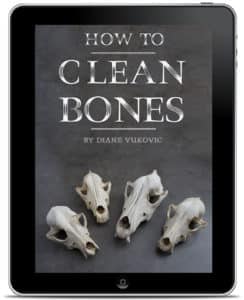
Want to become a bone cleaning expert? Check out my eBook. It'due south got lots of tips and tricks about how to clean and whiten all types of animal bones. Get it here for $4.99
Bound to:
- What Are Antlers?
- Velvet vs. Hard Antlers
- Antlers vs. Horns
- Preserving Shed Antlers
- Velvet Antlers
- Cleaning Skulls with Antlers
- Removing Tissue
- Whitening the Skull
- Mounting and Displaying
What Are Antlers?

Antlers aren't just beautiful, they are also very intricate and downright cool parts of the body. They start off as living tissue then plough into something which is more akin to bone.
In whitetail deer, antlers outset growing when the male person is about 6 months old. Growth is triggered by how much lite there is. More than lite means the beast produces less of the hormone melatonin, which kicks off the antler growing flavour. Numerous other hormones are also involved in antler growth.
Cool fact: Antlers are the fastest growing tissue in the animal kingdom. They tin can grow half to over an inch per day! By contrast, human hair merely grows at about one inch per month. (1)
Velvet Antlers vs. Difficult Antlers
When the antlers first start growing, they demand a lot of nutrients to sustain their rapid growth. Lots of blood and h2o flow throughout the antlers, which is why they are softer during this early menses. During this flow, the antlers are covered with a soft fuzz called velvet.
By the end of the growing flavor in fall, a burr starts to class at the base of the antlers. This burr cuts off claret menses. The antlers start to harden and the velvet falls off. They become from beingness full of blood to existence more often than not (80%) calcium and phosphorus.
The velvet which falls off the antlers is actually very high in nutrients and is eaten past many animals. It's also been used in lots of folk medicines. (2, iii)
Antlers vs. Horns
The methods of preserving antlers beneath volition NOT work on horns. Different antlers, horns are not bone structures. Horns are actually fabricated of two parts: The outer part is a sheath made out of keratin, which is the same material that our fingernails are made out of. The inner office is a bone core.
The horn sheath is very delicate. If you soak them in h2o, the sheath will crack and misconstrue. As well, if you leave the skull to beetles or other insects, the insects might eat the horn sheath.
If y'all want to save the horn sheath, you volition need to remove it from the skull and clean it out earlier proceeding with whatsoever of the other steps (removing tissue, degreasing, whitening). I talk more nigh how to preserve horns in my eBook (go information technology hither)
Preserving Shed Antlers

By the time a deer (or moose, elk, caribou…) has shed its antlers in fall, all of the living tissue in the antlers volition have dried up. This means that these shed antlers are very easy to preserve. You don't even take to practice anything – but get out them somewhere to dry and you are finished.
However, antlers can sometimes lose their color or crack. Follow these steps to ensure your antlers are preserved for a lifetime:
Step 1: Cleaning the Shed Antlers
If the antlers aren't likewise dirty, you tin exercise this simply by rubbing them with a cloth. Withal, if the antlers are very dirty, and so you'll desire to soak them in soapy water for a few minutes (Dawn dish lather works well). Then take a soft-bristled brush and gently scrub away the debris. You tin can likewise endeavor scrubbing them with a bit of baking soda.
What if the antlers are really muddied, such as covered in moss?

You can spray a bit of hydrogen peroxide onto them and then scrub. This will help remove stains and discoloration.
All the same, the hydrogen peroxide will likewise whiten the antlers a bit, which ruins their natural colour. But, the moss and dirt would take probably already ruined the colour anyway. You can always effort to re-color them afterward (as talked near Stride 3).
Step 2: Let the Antlers Dry
Allow the antlers dry at least a mean solar day or two before y'all put any blanket on them. Otherwise the coating might trap moisture inside the antlers, causing them to rot or cleft afterward on.
Pace 3: Coloring Stained or Whitened Antlers

If the antlers were left outside in the sun for a long time, they might lose their colour. As well, if you had to use hydrogen peroxide to clean the antlers, they might be whitened. IMO, I think the natural colour looks better on antlers. There are some things you lot tin do to bring the natural color back.
Hither are some options:
- Tea
- Henna
- Coffee grounds
- Forest stain (use matte and not shiny)
- Acrylic paint: make sure it is applied in a VERY THIN coat
Pace 4: Protective Coatings for Antlers
Putting a coating on the antlers will assist preserve the natural color from fading. It tin likewise prevent moisture from getting into the antlers (which might be an issue if y'all live somewhere boiling).
There's a lot of controversy about which is the "best" coating for antlers. Anybody has their favorite.
Here are some options that won't make an unnatural shiny coating:
- Linseed oil
- One part linseed oil + one part turpentine
- Former English furniture scratch cover
- Scotts Liquid Gold
- Wood stain (flat exterior clear polyurethane: Should say for Outside utilize and non-yellowing on the tin)
Tips for Applying the Coating:
- Use a rag for linseed oil. For polyurethane, utilise a soft-bristled paint brush.
- Several lite coats are better than a few thick coats.
- Choose "matte" over "shiny" when buying whatsoever sealants
Velvet Antlers

Preserving velvet antlers is actually very catchy and normally requires professional equipment. The reason information technology is and so tricky is because velvet antlers are more often than not made of living tissue. Yous have to preserve the actual antlers and so pickle the velvety hide.
If you don't get all the blood out of the antlers speedily and dry them, then they volition start to rot! Too, at that place'due south a lot of problems with insects and rodents eating the velvet.
Fifty-fifty if you practice manage to preserve the interior bone office of the antler, it'south a lot harder to preserve the actual velvet. Often, the velvet will start to fall off if you touch it. Many professional person taxidermists won't even offer guarantees on velvet antlers because they are and so catchy and sensitive.
I mention this not to discourage you lot, but to be realistic: It is tricky to preserve velvet on antlers. So don't be disappointed if it doesn't work out.
In the Field:
If you won't exist able to have the antlers habitation for a while, then you will need to take steps in the field to preserve them.
The simplest method is this:
- Sever animate being head and skin it. Remove as much flesh equally possible.
- Or, if you don't want to go along the entire skull, remove the antlers from the skull or saw off the skull plate. Here's a video that shows you how.
- Poke holes in the tips of the antlers with a needle or knife point.
- Hang the antlers upside down. This will aid blood drain out of the antlers.
- Try to proceed the antlers out of the sun and as absurd as possible. It'south of import that the antlers are high enough up then animals tin can't go to them.
This method should keep the velvet antlers safe for about 24 to 48 hours. Withal, it really depends on the antlers and conditions. Some velvet antlers plow to rotting, stinking mush in less than a twenty-four hour period. Others do okay for a few days.
If y'all are able to get your hands on formaldehyde or other professional person equipment, then you tin outset the preservation process in the field. This involves bringing a hypodermic needle and injecting the velvet antlers with formaldehyde. At that place'south a good description of how to do it hither.
I personally wouldn't recommend this because formaldehyde can be very unsafe to work with – peculiarly while outdoors. If you get some of it on your fingers (similar when trying to motion antlers that haven't dried withal), yous could end up with serious injuries.
At Dwelling house
The key to preserving velvet antlers is to dry out all of the living tissue quickly before it starts rotting. There are three main means that taxidermists (pros and amateurs akin) will exercise this with velvet:
Option 1: Rittels Preserve-It
At that place'southward a taxidermy product called "Rittels Preserve-Information technology" which many people have used to preserve velvet antlers with success. Hither's what you demand to exercise:
- Poke many small holes throughout the velvet antlers
- Get a hypodermic syringe and fill it with the preserving solution
- Start at the base of the antlers and start pumping solution into the antlers; you'll need to inject it into the veins.
- Keep injecting until the solution starts coming out of the holes y'all made. Yous want to force blood out of the antlers. The solution dripping out should go from pink to articulate.
- Paint some of the solution (or spray it) onto the outside of the antlers.
- Hang the velvet antlers upside downward and let them dry out for 2-three weeks.
Annotation that a lot of professionals say that this method doesn't piece of work well. That's because it is so hard to get the solution throughout the entire antlers. Y'all finish up getting the preserver around the injection only. Eventually, the velvet antlers first to rot. Maybe the antlers actually do dry out well – but the velvet falls off at the slightest touch. (4)
Option 2: Alcohol Soaking
Alcohol is a cool substance because it forces h2o out of surfaces. If y'all soak velvet antlers in pure alcohol, the claret and water will exist forced out and dry the antlers. The alcohol also kills any bacteria that might be in the antlers.
Hither's how to use this method:
- Submerge the antlers in alcohol for almost 12 hours
- Then put the antlers in a solution of Borax for 12 hours. You desire to apply every bit much Borax as possible in your solution while still getting a articulate solution. If the solution isn't clear, you'll terminate up Borax rest on the velvet.
- Echo step ane.
- If the horns aren't hard by this point, then repeat all the steps. Information technology's important that the alcohol soak is the concluding stride. (5, half-dozen)
Option three: Tanning Solution
Instead of using alcohol, you can get tanning solution from a taxidermy supply shop. Then soak the velvet antlers in the solution for about iii weeks.
After soaking, hang them to dry. It can have several weeks for them to become fully dry.
Freeze Drying Velvet Antlers
Some professionals volition freeze dry velvet antlers to preserve them. There'southward too contend about how well this method works. The process is generally really good at preserving the appearance of the antlers, but it doesn't actually remove blood (it just dries it). So freeze stale velvet antlers can odor bad.
In any case, you won't be able to this at abode. Freeze driers are really expensive. You lot tin't do information technology in a normal freezer because of the condensation that ends upwards forming – not to mention that information technology would take months if not years to exercise it in a dwelling house freezer!
Cleaning Skulls with Antlers
Information technology's really actually piece of cake to make clean basic of animals that have antlers. That's because antlered animals are herbivores, and and so their basic aren't as greasy as those of omnivores like bears, opossums, or pigs (which are a pain in the donkey to degrease).
To clean the skull with the antlers, all y'all really demand to do is remove the tissue and whiten with hydrogen peroxide. The trick is to keep the antlers from getting messed upwardly in the process. Here's how to do it.
Footstep 1: Removing Tissue
There are a lot of means to clean tissue off of animal skulls. I talk almost them in this mail service. Before you get-go removing the tissue, bank check out the status of the antlers. Are they hard? Or are they all the same velvet?
If the antlers are hard…

I personally prefer leaving the skull outside for bacteria and insects to make clean. This is very effective at getting rid of hidden $.25 of tissue in the skull. Y'all tin also bury the skull. Leave the antlers sticking out of the ground then they don't become stained past dirt.
Annotation that many small animals actually chew on bones and antlers to get nutrients. You lot should put a wire cage around the skull/antlers to go along them safe.
Soaking (aka maceration) as well works well to remove tissue. The water won't damage the antlers. A lot of people recommend boiling skulls considering it'due south the fastest way to get tissue off. However, it can as well damage the os. If you are in a hurry, simmer instead of boil and brand sure the antlers are sticking out of the pot.
If the antlers are withal velvet…
So y'all'll need to preserve the velvet antlers earlier you keep with tissue removal. Otherwise, bacteria or insects will eat the velvet antlers.
Besides never simmer skulls with velvet antlers. Even if the velvet antlers are preserved, the steam coming upwardly from the water will damage the velvet!
Step 2: Whitening Antlered Skulls
The best manner to whiten bones and skulls is to soak them in a solution of hydrogen peroxide. If y'all don't know how to do it, meet these instructions on how to whiten bones. However, as a general rule, you should never whiten antlers. They don't look virtually as practiced when whitened. It'due south better to keep their natural color.
That means you need to find a mode to soak the skull without getting the antlers. Here are some solutions:
Wrap the base of the antlers with plastic wrap
Yous'll demand to wrap around them at least six times. Then follow this with electric tape, making sure the antlers are wrapped very tightly. The plastic wrap should continue hydrogen peroxide from touching the horns during whitening.
Make a Hydrogen Peroxide Paste
This is a trick I came up with for whitening really large skulls. Hither's what you practise:
- Make a paste out of hydrogen peroxide and baking soda
- Paint it onto the skull, taking intendance to avoid the antlers
Once you have whitened the skull, you tin then coat the antlers equally talked well-nigh in the department about Preserving Shed Antlers.
Mounting the Antlers for Display
Once you've got the skull and and whitened and the antlers coated, then you tin can brandish them. In that location are a lot of ways to do this. Some people similar to make cool art projects out of the antlers. I hang necklaces from mine.
Or yous tin go the traditional route and get a European Skull Mount kit. Below are some good options. Make sure you check the size of the mount before getting information technology. Some are just suitable for small skulls and antler racks!
Skull Hooker Skull Mount Kit(for unabridged skulls)


Antler Mountain Kit (for just antlers due west/o skull cap)


Skull Hooker European Bays Mount (for antlers with skull cap)


Solid Oak Table Display (for entire skulls)


Image credit: "Ants with antlers" (CC Past 2.0) by Guttorm Flatabø

Source: https://momgoescamping.com/how-clean-antlers/
Posted by: cagleouggialk1992.blogspot.com
0 Response to "How Do You Clean The Flesh Off Deer Antlers"
Post a Comment